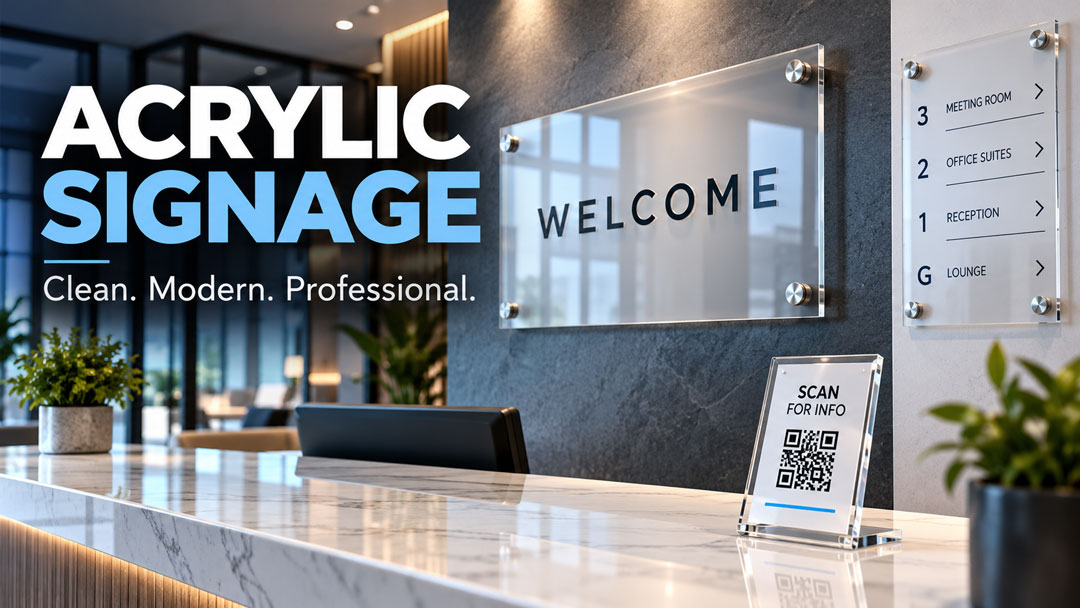
Acrylic signage is one of the most versatile options for businesses that want a clean, polished, and contemporary physical presence. It can be used for reception logos, office nameplates, clinic signs, department directories, counter displays, QR stands, room signs, and retail branding without making the space feel visually heavy.
Unlike temporary printed materials, acrylic creates a more permanent visual element that can become part of the interior itself. Clear, frosted, colored, mirror, and layered finishes allow businesses to create different looks while keeping the presentation professional.
Infinity Hub currently offers acrylic signage as part of its in-house Printing Services in Davao City, with available options including different finishes, thicknesses, mounting styles, print or vinyl applications, and selected lighting configurations depending on the project. Infinity Hub
The right result, however, depends on more than choosing acrylic as a material.
Here are nine things businesses should consider before producing an acrylic sign.
1. Decide What the Acrylic Sign Needs to Do
Before thinking about color or thickness, define the purpose.
A reception logo has a different job from a room sign. A QR-code stand has different requirements from an office directory. A storefront logo may need completely different visibility and durability considerations from a wall-mounted interior sign.
Common uses for acrylic signage include reception branding, office names, department identification, directories, clinic signage, counter displays, door signs, retail signs, and branded information panels. Infinity Hub’s current printing service lists many of these applications specifically. Infinity Hub
Start by asking what information customers need and how far away they will see the sign.
If it is primarily decorative branding, the logo may deserve almost all the visual attention.
If it is directional or informational, readability becomes more important than visual complexity.
Purpose should come first.
2. Choose the Right Acrylic Finish
One reason acrylic signage is so flexible is the variety of finishes available.
Clear acrylic creates a clean, almost floating appearance. Frosted acrylic can feel softer and more private. Colored acrylic can reinforce brand identity. Mirror acrylic creates a more decorative, premium appearance when used appropriately.
Infinity Hub’s current Printing service offers clear, frosted, colored, and mirror acrylic options depending on project requirements. Infinity Hub
The finish should support the environment.
For example, a clear acrylic logo can work extremely well against a textured wall because the background remains visible. A clinic might prefer frosted acrylic for a calmer, more professional visual style. A beauty or retail brand might use mirror acrylic as a stronger decorative element.
Do not choose the finish simply because it looks impressive in a sample.
Choose the one that fits the brand.
3. Use Acrylic Signage to Strengthen Reception Areas
The reception area is often where customers form their first physical impression of a company.
They may already know the business from Google, social media, advertising, or its website. The moment they walk through the door, the physical environment should confirm that they have arrived at the same brand.
This makes acrylic signage especially effective behind reception counters or waiting areas.
A wall-mounted acrylic logo can provide visual confirmation without dominating the room. Standoff mounting can also create a slight floating effect by positioning the panel away from the wall.
For businesses such as clinics, agencies, salons, professional offices, hotels, real-estate companies, and corporate spaces, this can create a more finished visual environment.
Infinity Hub also connects printing with its existing branding and graphic-design capabilities, allowing physical materials to be produced from the same brand files used across digital channels. Infinity Hub
That consistency matters.
4. Keep the Design Simple
Acrylic is visually clean, so overcrowding it usually works against the material.
Strong acrylic signage often contains only the information customers actually need.
A reception sign might contain the logo and company name.
A room sign might contain the department name and room number.
A directory can contain multiple names because information is the primary purpose.
The amount of content should match how the sign is used.
Avoid squeezing an address, website, telephone number, tagline, social handles, full service list, and QR code onto one decorative wall sign unless there is a clear practical reason.
Minimalism is not simply a visual trend here.
It improves readability.
Your Infinity Hub Graphic Design service can support the layout stage so the physical sign follows the same visual system as other brand materials.
5. Consider How the Sign Will Be Mounted
Mounting affects how acrylic signage looks almost as much as the acrylic itself.
A panel mounted flat against a wall creates one appearance. A panel installed with metallic standoff pins creates another. Individual acrylic letters can create a different effect again.
Infinity Hub notes that acrylic signs can be mounted flat or with standoff pins so the sign sits away from the wall. Infinity Hub
Before finalizing the design, consider the wall.
Is it painted concrete?
Glass?
Wood?
Stone?
ACP?
Wallpaper?
A heavily textured wall can affect installation and visibility differently from a smooth white interior.
The surrounding material also influences contrast.
A transparent acrylic sign on a visually busy wall may become difficult to read unless the design includes sufficient color or backing.
Installation is part of the design decision.
6. Think About Lighting
Some acrylic signage can also incorporate lighting, depending on the construction and intended design. Infinity Hub
But lighting should serve a purpose.
A reception area that is already brightly illuminated may not need additional LED lighting behind the sign. A darker wall or evening-facing space may benefit more from it.
Lighting can be used to create emphasis, improve visibility, or produce a more dramatic brand presentation.
The question should not be:
“Can we add lights?”
It should be:
“Will lighting improve the customer experience or visibility?”
If the answer is no, a well-produced non-illuminated sign may look more refined.
Professional signage is not about adding every available feature.
It is about choosing the right ones.
7. Make the Physical Business Name Match the Digital Brand
Your physical identity should match how customers know you online.
Google’s Business Profile guidelines recommend representing a business consistently across real-world signage, stationery, websites, and other branding. Google Help Google also instructs businesses to enter their Business Profile name as it appears on real-world signage and other branding. Google Help
This makes acrylic signage particularly relevant for physical businesses working on their local visibility.
If the website says:
ABC Wellness Clinic
but the reception wall says:
ABC Medical & Aesthetic Center
while Google shows:
ABC Wellness Davao
customers and search platforms may encounter inconsistent branding.
Keep the core business name consistent.
This is especially important if the acrylic sign is your primary permanent business identifier.
Google’s storefront-verification guidance also says businesses may need to show a permanent fixture displaying the business name during video verification. Google Help
So the sign can serve both branding and practical business-verification purposes.
8. Use Acrylic Signage Beyond the Main Logo
Many businesses assume acrylic is only for a large reception logo.
It can do much more.
A complete physical branding system can use acrylic signage throughout the customer journey.
For example, the reception logo welcomes visitors.
A directory helps them identify departments.
Room signs guide them to the correct office.
A counter sign can display payment instructions.
A QR stand can connect customers to a digital menu, booking page, review form, product catalog, or website.
Acrylic can therefore function as both branding and information design.
This is particularly useful in clinics, hotels, office buildings, retail environments, salons, restaurants, showrooms, schools, and other spaces where customers move through multiple touchpoints.
Instead of thinking about one sign, think about the environment.
9. Connect Acrylic Signage With Digital Marketing
Physical signage can also become part of your digital customer journey.
A QR code printed or applied to an acrylic counter sign can lead customers to online actions such as booking an appointment, viewing a menu, leaving a Google review, registering for an event, opening a catalog, or following a social account.
This creates a useful connection:
Online Discovery → Physical Visit → Digital Action
For example, a customer might discover your clinic through Google, arrive and recognize your acrylic signage, complete their visit, then scan a counter QR code to schedule the next appointment.
Infinity Hub’s broader Digital Marketing services can connect physical marketing materials with websites, social media, paid campaigns, SEO, and other customer touchpoints.
The physical and digital sides of the brand should reinforce one another.
Acrylic Signage vs. Build-Up Signage
These two options are often confused because both can create polished business signs.
Acrylic signage usually uses acrylic sheet, panels, plates, or cut acrylic components. It is commonly used for reception areas, offices, directories, clinics, door signs, counters, and interior branding.
Build-up signage uses individually fabricated dimensional letters or logo pieces that create greater depth.
Infinity Hub currently produces build-up letters using materials such as acrylic, stainless steel, brass, and aluminum, with front-lit, halo-lit, or non-lighted options depending on the project. Infinity Hub
Acrylic may be ideal when the design needs a sleek panel or refined interior finish.
Build-up letters may be stronger when the business name needs greater architectural presence or visibility from farther away.
Neither is automatically better.
Choose according to the application.
Acrylic Signage vs. Printed PVC or ACP Panels
Printed PVC or ACP panels are also common signage materials.
They can be practical for larger information panels, facade applications, or areas where printed graphics need to cover more surface area.
Acrylic signage typically creates a more refined or dimensional look, especially in customer-facing interiors.
The choice depends on:
- Location
- Viewing distance
- Desired appearance
- Budget
- Exposure
- Expected lifespan
- Installation surface
For large outdoor messaging, another material may make more practical sense.
For a polished reception logo, acrylic may be the better fit.
The production team should recommend material based on the environment rather than automatically using the same solution for every project.
When Acrylic Signage May Not Be the Best Choice
Acrylic is versatile, but it is not appropriate for every situation.
A very large temporary promotional message may be better produced as tarpaulin.
A building facade needing large dimensional illuminated letters may benefit more from build-up signage.
A large flat information panel may be better suited to another rigid substrate.
Good acrylic signage planning also means knowing when not to use acrylic.
The purpose, environment, viewing distance, durability requirement, and budget should determine the final specification.
That is one reason Infinity Hub’s Printing workflow begins by reviewing the location, dimensions, intended use, and design before final material recommendations are confirmed. Infinity Hub
What to Prepare Before Requesting an Acrylic Signage Quote
To make quoting and production easier, prepare basic project information before contacting the printer.
Useful details include your preferred dimensions, quantity, installation location, indoor or outdoor use, wall photo, logo files, preferred finish, whether you want lighting, and your target completion date.
If you do not know the appropriate thickness or finish, you do not need to guess.
Send photos and explain the result you want.
Infinity Hub’s current ordering process includes request review, artwork or file checking, material recommendations, written quotation, proof approval, production, and release or installation arrangements. Infinity Hub
That proof stage is important.
Check spelling, logo proportions, colors, dimensions, and positioning before production begins.
Why Acrylic Signage Works Well for Professional Brands
The appeal of acrylic signage is not simply that acrylic looks modern.
It is the combination of versatility and visual restraint.
It can create a clean business identity without making a space feel overly commercial.
For offices, clinics, hotels, salons, agencies, showrooms, and retail environments, that balance can work extremely well.
When designed properly, the sign becomes part of the environment rather than something that looks temporarily attached to it.
That is usually what businesses are trying to achieve.
Frequently Asked Questions
What is acrylic signage?
Acrylic signage refers to signs produced using acrylic sheet or cut acrylic components. They can be clear, frosted, colored, mirrored, printed, finished with vinyl, mounted flat, or installed using standoff pins.
Where is acrylic signage commonly used?
It is commonly used for reception logos, office nameplates, directories, room signs, clinic signs, counter signs, QR displays, retail signs, and interior branding.
Can acrylic signs be illuminated?
Some acrylic sign designs can incorporate lighting. Whether lighting is appropriate depends on the design, installation site, visibility needs, and budget. Infinity Hub confirms lighting options per project.
What is the difference between acrylic signage and 3D letters?
Acrylic signage commonly uses panels, plates, or cut acrylic components. Build-up signage uses individually fabricated raised letters or logos to create greater dimensional depth.
Can Infinity Hub design acrylic signage?
Yes. Infinity Hub can create the layout using existing logo and brand files or review supplied artwork before production.
Does Infinity Hub produce acrylic signage in Davao?
Yes. Printing and fabrication are handled from Infinity Hub’s Davao City operation, and businesses in GenSan, Tagum, and other Mindanao locations can also inquire about orders and delivery.
Give Your Physical Brand a Cleaner Finish
Customers experience your brand long before and after they see an advertisement.
They experience it when they arrive at your office.
When they enter reception.
When they look for the correct department.
When they scan a QR code.
When they recognize your logo on the wall.
Professional acrylic signage helps those physical moments feel connected to the same business customers already know online.
Start with the purpose.
Choose the finish around the brand.
Design for the actual viewing distance.
Consider the mounting surface.
Use lighting only when it adds value.
And keep the business identity consistent across physical and digital touchpoints.
Infinity Hub’s Printing Services include acrylic signage, business signage, tarpaulin printing, and build-up signage with dimensional letters, all coordinated through its Davao City printing operation. Infinity Hub
Explore Infinity Hub Printing Services
Acrylic signage does not need to shout to look professional. Sometimes the cleanest sign creates the strongest impression.
For outbound SEO, this article already has two strong external-authority opportunities: Google’s recommendation to keep your real-world signage consistent with your Business Profile identity, and Google’s storefront-verification requirement for permanent business signage. Google Help